Myth of Mossadegh
- Shayan Goodarzifar

- May 7
- 2 min read
The idea that “the CIA destroyed Iran in 1953” has become one of the most repeated simplifications in modern political discourse about Iran. It’s often used as a catch-all explanation for decades of Iranian history that followed, as if a single covert operation in Washington erased all internal complexity inside Iran itself.
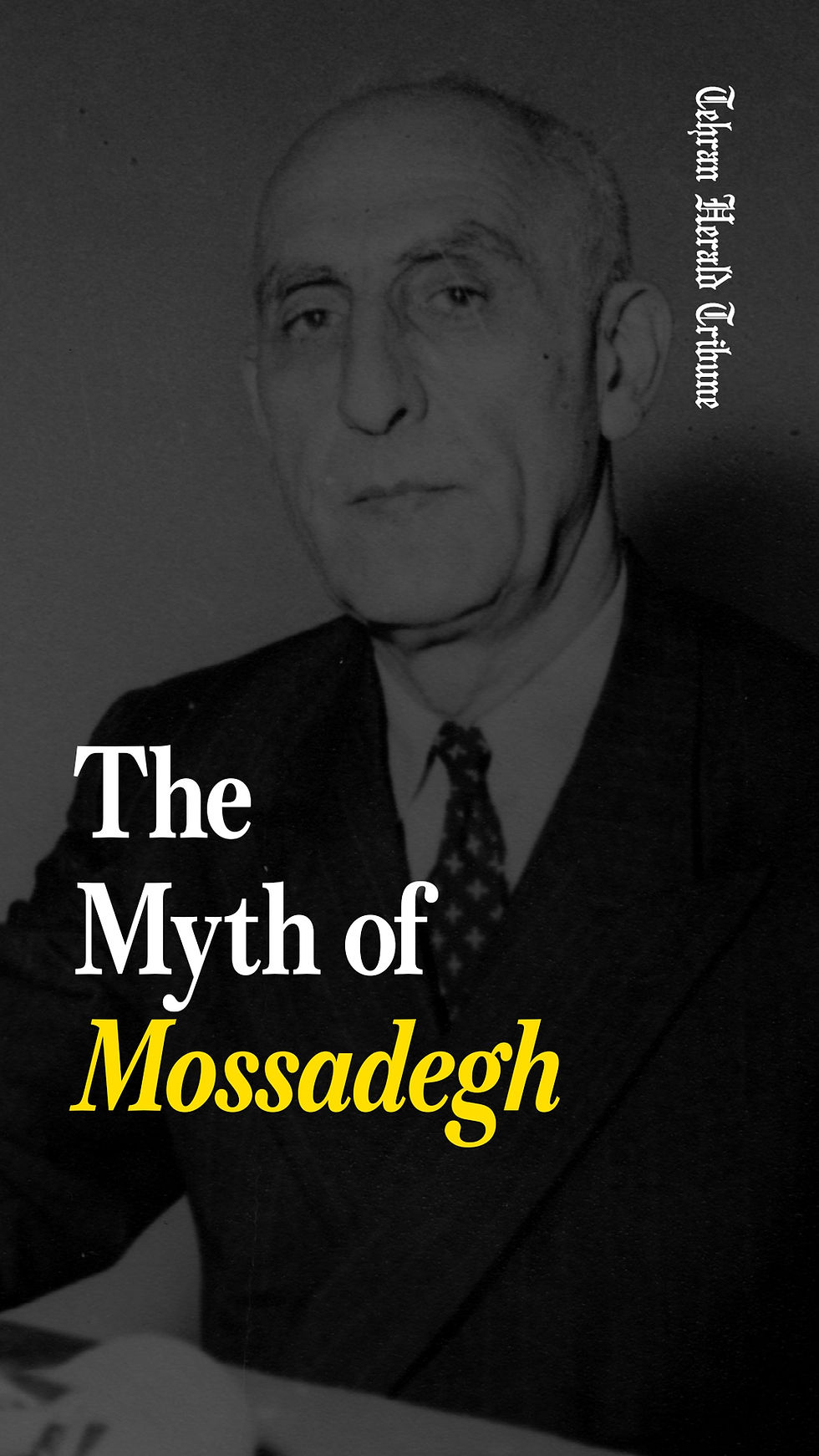
What actually happened in 1953 is far more documented and widely discussed than the simplified version suggests. Mohammad Mossadegh, Iran’s prime minister at the time, rose to power through a nationalist political movement centered on oil nationalization and reducing foreign control over Iran’s resources. His government’s decision to nationalize the Anglo-Iranian Oil Company triggered a major confrontation with Britain, which imposed economic pressure and sought international support to remove him from power. The United States later joined Britain in a covert operation that contributed to his removal and the strengthening of the Shah’s monarchy. This is broadly supported in historical records and declassified intelligence accounts.
However, the reduction of everything that followed in Iran to this single intervention ignores the internal political reality of the country at the time. Iran in the early 1950s was not a politically settled or ideologically unified system. It was a fragmented political environment with competing nationalist groups, royalists, communists, clerical networks, and military factions all operating in tension with one another. Even Mossadegh’s own position was not politically stable, as his government increasingly relied on emergency powers and faced opposition from multiple internal blocs.
Economic pressure also played a role in destabilizing the situation. After oil nationalization, Britain imposed an embargo that significantly reduced Iran’s oil revenue and placed strain on the state’s financial capacity. This created additional internal political stress at a moment when institutions were already fragile and competing power centers were intensifying their struggle.
Where the modern narrative becomes oversimplified is in treating the coup as the sole origin point of all later Iranian political developments. While the 1953 intervention is widely recognized as a turning point in Iran’s modern history, it did not exist in a vacuum, nor did it erase the internal political dynamics already shaping the country. Historical analyses consistently show that the coup interacted with, rather than replaced, existing tensions inside Iranian society and governance structures.
Reducing Iran’s entire modern political trajectory to a single external operation turns a complex historical process into a simplified moral story. It removes the internal political conflicts, ideological struggles, and structural decisions that continued shaping Iran long after 1953.
In reality, 1953 is better understood as one major inflection point in a much longer and internally driven political evolution—not the singular explanation for everything that followed.


Comments