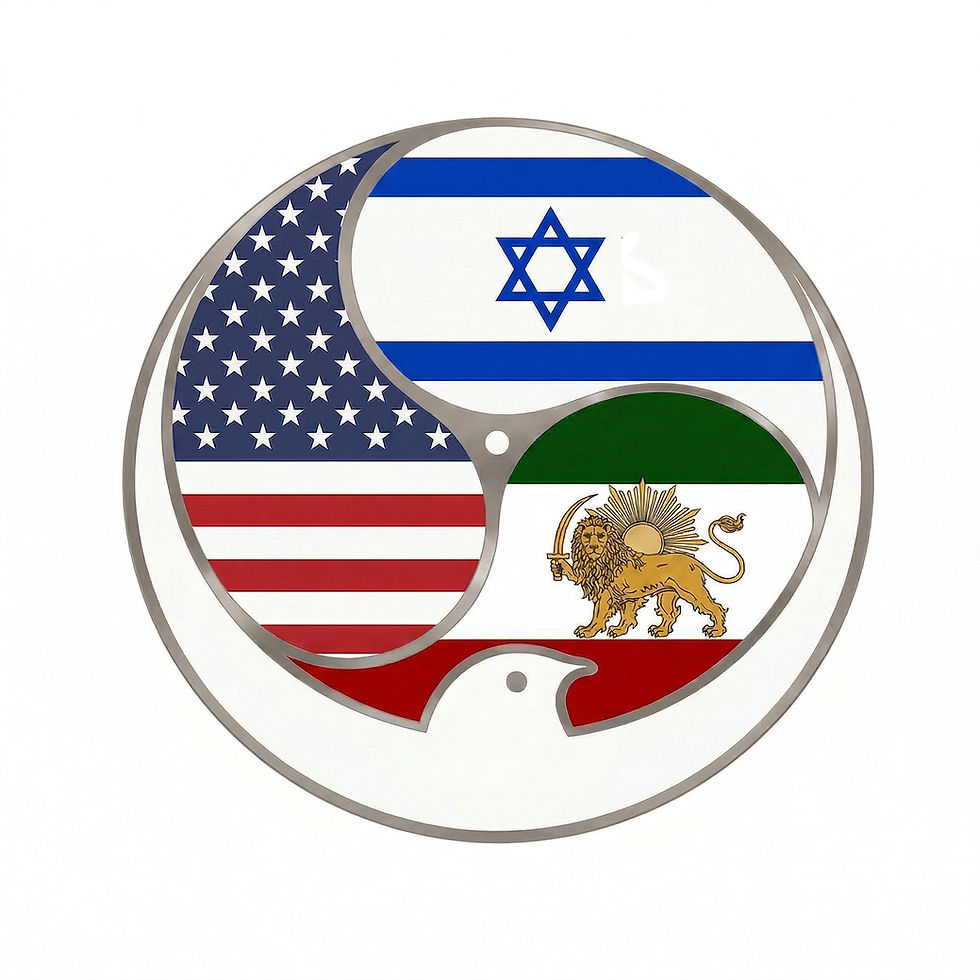
Cyrus Accords: Why Iranian identity is tied deeply with Israel.
- Shayan Goodarzifar
- 4 days ago
- 3 min read

Every political struggle eventually reduces to a single question:
who has the right to decide how a people lives?
Not how they should live in theory, not what ideology suits them best—but who ultimately holds authority over their existence.
Zionism answers that question in one way: the Jewish people themselves.
The Iranian struggle for freedom answers it the same way: the Iranian people themselves.
Different histories, same principle.
The Moral Logic of Self-Determination
At the heart of modern political thought—from John Locke to Jean-Jacques Rousseau—is the idea that legitimacy comes from the consent of the governed. A people is not an object to be ruled; it is a subject that defines its own political reality.
Zionism is an extension of that idea under extreme conditions. It emerged from a recognition that without sovereignty, consent is meaningless—because decisions are always made elsewhere, by others, often at the expense of those without power.
The conclusion is uncomfortable but clear:
freedom requires control, not just aspiration.
Iranians, confronting decades of imposed authority under the Islamic Republic of Iran, are wrestling with that same realization. The demand is not simply for reform—it is for ownership over the political structure itself.
The Universality of the Claim
If you accept that Iranians have the right to determine their own future, you are already accepting the core moral claim of Zionism.
To deny that same right to another people is not nuance—it is inconsistency.
You cannot coherently argue that:
Iranians deserve self-determination
but Jewish self-determination in Israel is illegitimate
Without introducing an arbitrary distinction that weakens the entire framework.
Philosophically, rights that apply selectively are not rights—they are preferences.
Freedom as a Non-Negotiable Principle
There is a tendency, especially in political discourse, to treat freedom as something that can be partitioned, negotiated, or conditionally applied.
But if freedom depends on approval—international, ideological, or moral—then it is no longer freedom. It is permission.
Zionism rejects that logic. It asserts that the right to exist as a political entity does not depend on universal agreement.
For Iranians, this is not an abstract idea. It is a lived reality. Every protest, every act of defiance, carries the same implicit claim:
we do not need authorization to be free.
The Role of Opposition
The hostility toward Israel embedded in the ideology of the Iranian regime is not incidental. It serves a function: to define an external enemy that justifies internal control.
To accept that framing—even passively—is to allow the regime to extend its authority beyond borders, shaping not just policy but perception.
Rejecting that hostility is therefore not merely a geopolitical stance. It is an assertion of intellectual independence.
It is the act of reclaiming judgment.
Alignment as an Act of Consistency
Supporting Zionism, in this context, is not about adopting a foreign identity or ignoring the complexities of the region.
It is about consistency.
If one believes that:
people have the right to self-govern
legitimacy comes from internal will, not external approval
and freedom must be actively secured
Then recognizing the Jewish claim to self-determination is not optional—it follows logically.
And once that recognition is made, alignment becomes less about politics and more about coherence.
The Cost of Clarity
This position is not comfortable. It forces a break with dominant narratives, invites criticism, and eliminates the safety of ambiguity.
But philosophical clarity has always come at a cost.
To stand for a principle universally is to accept its implications everywhere—not only where it is convenient, but where it is contested.
Conclusion: One Principle, Two Struggles
The Iranian fight for freedom and the Zionist project are not identical. Their histories diverge, their contexts differ, and their outcomes are debated.
But at the level of principle, they intersect at something fundamental:
the refusal of a people to let others decide their fate.
For Iranians, embracing that principle fully means recognizing it wherever it appears—even when it challenges inherited narratives.
Because in the end, freedom is not a local idea.
It is either universal, or it is not real at all.


Comments