Professor of delusions: Why Jiang Xueqin is a charlatan.
- Shayan Goodarzifar
- 3 days ago
- 4 min read


Let’s begin with a small experiment in intellectual honesty. Imagine someone, with unwavering confidence, telling you that the United States would lose a war to Iran, that Iranians overwhelmingly adore their regime and could field “90 million soldiers,” and that Iran has somehow extracted trillions of dollars from warfare. You would not be wrong to pause and ask a very basic question: is this the product of careful study, or the sound of someone mistaking conviction for competence?
These are not stray comments overheard at a noisy dinner table. They are claims made by Jiang Xueqin, the architect of the YouTube brand “Predictive History,” who has taken to calling himself “Professor Jiang.” Now, one must admire the efficiency of this move. Why spend years earning academic recognition when one can simply assume the title and let the audience do the rest? Authority, in this case, is not demonstrated—it is declared.
But let us be fair. Titles, after all, are not arguments. So we turn to the arguments themselves—and here, things begin to unravel with almost theatrical speed.
Take the notion of “90 million soldiers.” This is not merely incorrect; it is the sort of claim that collapses under the gentlest application of arithmetic. A country’s population is not a standing army. Infants, the elderly, the infirm, the economically indispensable—none of these categories seem to trouble the imagination here. It is less a calculation than a gesture, a number chosen not for its accuracy but for its dramatic effect. One is reminded of the ancient habit of inflating enemy armies to mythological proportions—an effective storytelling device, though rarely a reliable analytical one.
The economic claim fares no better. The idea that Iran has generated trillions from war would be amusing if it were not presented in earnest. Iran’s economy, constrained by sanctions and structural limitations, is hardly a hidden engine of wartime profit on a scale that would make even the largest global economies blush. This is not a controversial point. It is simply a matter of observable reality.
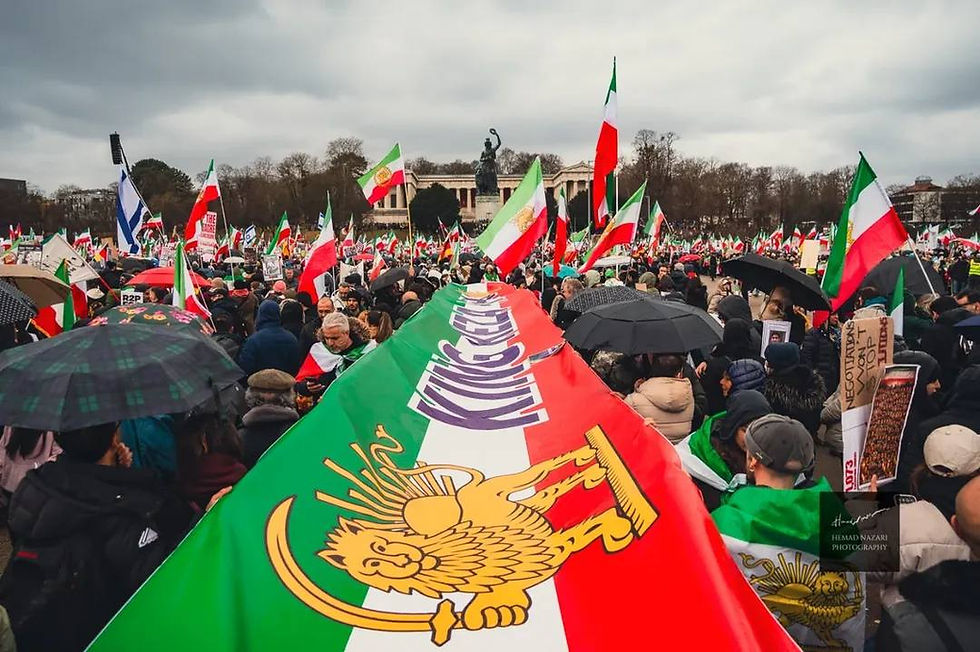
And yet, more troubling than numerical absurdities is the flattening of an entire nation into a single, obedient voice. The assertion that Iranians broadly support their regime requires one to ignore not only history, but recent history—protests, dissent, visible and persistent dissatisfaction both within Iran and across its diaspora. A society of tens of millions is reduced to a slogan. It is not analysis; it is erasure masquerading as insight.
At this stage, one might ask: what exactly is the method here? We are told that this is “prediction,” elevated to something like a science of history. But prediction, absent method, is little more than guesswork with good lighting. In any serious field—be it Geopolitics or otherwise—claims must be testable, assumptions must be stated, and errors must be acknowledged. Here, we find something closer to a theatrical production: the hits are celebrated, the misses discreetly forgotten, and the narrative remains intact regardless of outcome.
This is not science. It is what might be called the performance of science—the careful arrangement of language, references, and tone to simulate rigor without submitting to its discipline.
Beneath this performance lies a more familiar structure: the architecture of conspiracy. We are invited to believe in hidden systems, secret coordinations, and invisible hands guiding the course of history. Names like the Illuminati are invoked not as hypotheses to be tested, but as explanations to be accepted. Such frameworks possess a peculiar advantage: they cannot be disproven, because any contradiction is merely further evidence of the conspiracy’s reach. It is a closed loop, intellectually speaking—a system that feeds on itself.
Layered atop this is a kind of eschatological mood, a suggestion that history is not unfolding but rather revealing a predetermined script. The future, in this view, is less a field of possibility than a destination already chosen. It is a seductive idea. It relieves us of the burden of uncertainty. But it is also profoundly at odds with reality, where outcomes are shaped not by destiny but by decisions—messy, human, often contradictory decisions.
There is, however, a more serious cost to all of this. When narratives drift into claims about hidden global control tied to specific groups, they begin to echo some of the oldest and most corrosive ideas in modern history. These are not harmless speculations. They are intellectual shortcuts that have, time and again, justified exclusion, distortion, and worse. To dress them up in the language of “prediction” does not make them more credible; it merely makes them more palatable.
For Iranians, the stakes are not abstract. To portray them as uniformly loyal to a regime they have repeatedly challenged is to deny their agency. It is to tell a story about them that contradicts their own lived experience. And for anyone—whether in Israel or elsewhere—trying to understand the region, such narratives offer not clarity but confusion, replacing complexity with caricature.
What makes Jiang Xueqin compelling is not the strength of his evidence, but the confidence of his delivery. He offers something many people crave: certainty. A world that can be explained in sweeping strokes, governed by hidden patterns, and predicted with assurance. But certainty, when unearned, is not a virtue. It is a warning sign.
In the end, the issue is not that bold claims are being made. Bold claims, when properly supported, are the lifeblood of intellectual progress. The issue is that unsupported claims are being presented as structured knowledge, that speculation is being dressed as science, and that narrative is being mistaken for truth.
And that is not merely an error of judgment. It is, in its own way, a kind of
performance—one that rewards confidence over correctness, and storytelling over substance.


Comments